In twelve years of making corporate films across India — for pharmaceutical giants, manufacturing companies, government bodies, and fast-growing startups — one pattern repeats itself more than any other: companies brief their films around themselves, not around their impact.
The result is a film that tells us the company was founded in a particular year, has a certain number of employees, operates from multiple locations, and has plans to expand. Then the Managing Director speaks directly to camera for two minutes. Then there are drone shots of the building. Then it ends.
Sound familiar? It should. Because that is what 80% of corporate films in India look like right now.
The Corporate Film Formula Problem
InfographicWhy Does This Keep Happening?
The answer is simpler than most companies expect: the brief goes to a production house, not a communication strategist.
A production house asks you what you want to show. A communication strategist asks you what you want the viewer to feel, believe, and do after watching. These are completely different starting points — and they produce completely different films.
When the brief starts with "show our factory, show our team, show our director", the film becomes a tour. When the brief starts with "what has this company changed in the world?", the film becomes a story. And stories are what stakeholders — investors, buyers, partners, employees — actually pay attention to.

"A production house asks you what you want to show. A communication strategist asks you what you want the viewer to feel, believe, and do. These are completely different starting points — and they produce completely different films."
Jay Ghelani · Founder & Video Strategist, Cosmos ProductionWhat Stakeholders Actually Want to See
Here is what twelve years of making corporate films across industries has taught me about what different stakeholders actually respond to:
* Based on Cosmos Production's experience across 4,000+ corporate film projects across pharma, manufacturing, FMCG, and corporate sectors.
Notice the gap. The elements most companies prioritise in their corporate films — the director's message, the building shots, the company introduction — are the elements stakeholders care about least. The elements that build trust — impact, authenticity, process — are the ones most films barely mention.


The Concept That Changes Everything
The shift from "who we are" to "what we impact" is not just a creative choice — it is a strategic one. And it changes everything about how a corporate film is written, directed, and edited.

Do's & Don'ts of an Impact-Driven Corporate Film
After producing corporate films for clients like Zydus Pharma, Asian Paints, NHAI, and iCreate, here is what we have learned works — and what consistently fails:
-
01
Show the impact, not the intention Don't say "we are committed to quality." Show a scientist at 2am re-running a test because the numbers aren't right. That single frame communicates more than any voiceover ever could.
-
02
Let your people tell the story Real employees, real vendors, real clients — speaking naturally in their actual environment — build credibility that no script can manufacture. Authenticity is the most powerful production value.
-
03
Brief the film around a business goal Every corporate film should have a clear objective: win a tender, attract investors, onboard partners, build brand trust. The script should work backwards from that goal — not from a list of company facts.
-
04
Invest in pre-production strategy The script and narrative strategy should take longer than the shoot. A well-written brief produces a film that works for 3–5 years. A poorly written one produces footage that sits on a hard drive.
-
05
Make the viewer the hero, not the company The most powerful corporate films make the viewer feel like they will be part of something meaningful if they work with this company. The company is the enabler — the viewer is the hero.
-
01
Don't start with "We were founded in…" Nobody watching your corporate film is interested in your founding year in the first 10 seconds. They are asking one question: "What does this company do for me?" Answer that first.
-
02
Don't rely on the Director's message as your centrepiece A two-minute monologue from the MD is not a corporate film. It is a recorded speech. If a leader must speak, make it brief, make it specific, and make it about impact — not vision statements.
-
03
Don't list your achievements — show the proof "We have ISO 9001:2015 certification" means nothing visually. Show the process that earned that certification. Show the quality control, the testing, the standards in action. Let the viewer discover the achievement.
-
04
Don't use the same film for every audience The film you show to an investor is not the same film you show to a procurement head. The narrative emphasis, the language, and the call to action should change for every audience segment.
-
05
Don't sacrifice sound for visuals Most corporate films are shot on good cameras but have terrible audio. Professional sound design, voiceover quality, and music selection account for at least 40% of how premium a film feels. Never compromise on it.


Signs Your Corporate Film Is Forgettable
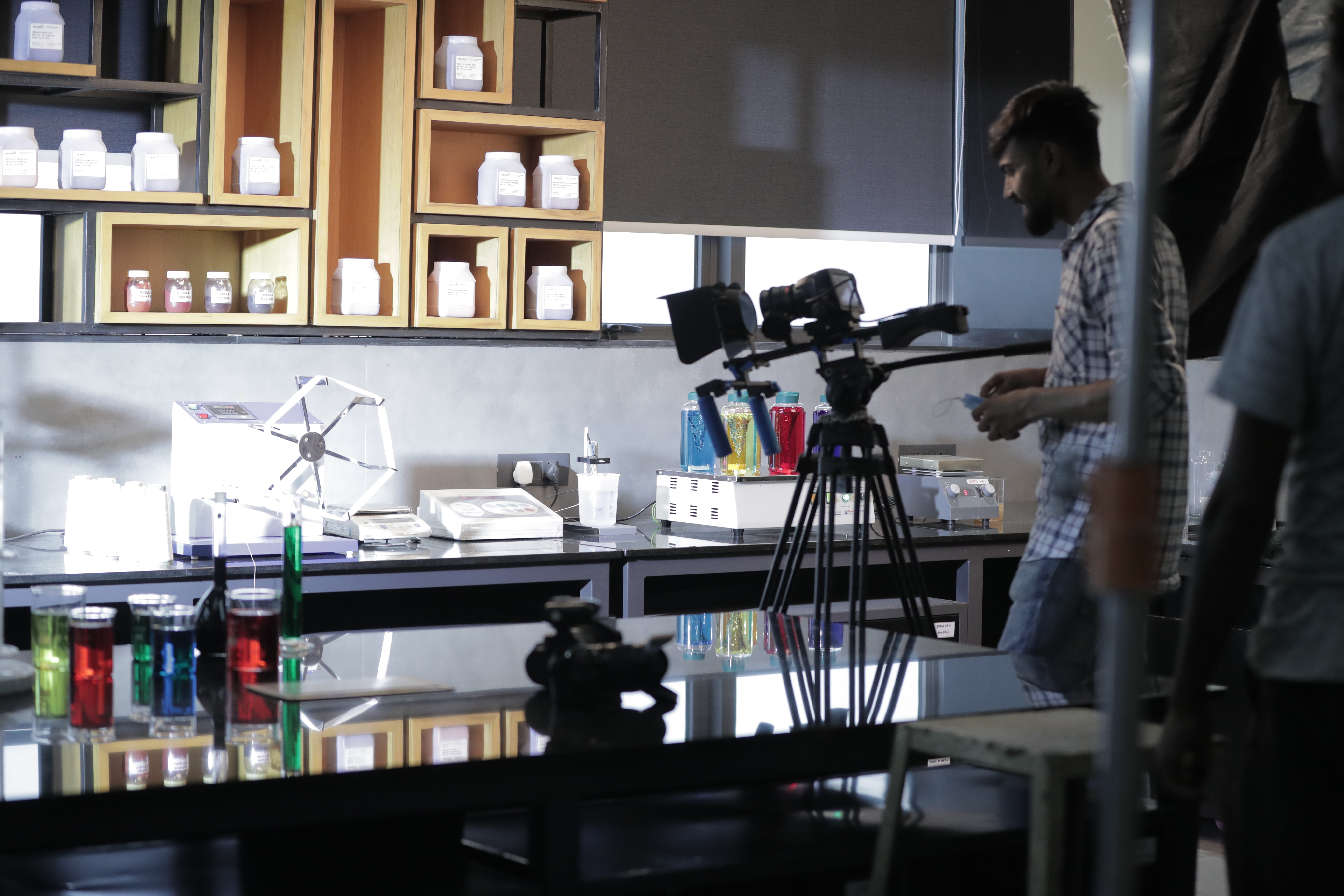 Behind the scenes · Cosmos Production
What This Looks Like in Practice
When we made the corporate film for a pharmaceutical company in Ahmedabad, the first brief we received was a standard one: show the factory, show the certifications, show the MD, show the team. We pushed back.
We asked them a different question: "What would India look like if your company didn't exist?"
That conversation led to a completely different film — one that opened inside a hospital, with a patient receiving medication. One that showed the 47-step quality process that gets a tablet from raw material to that patient's hand. One that ended not with a tagline, but with a doctor saying on camera: "I trust this brand."
The film has been used for investor presentations, export buyer meetings, and employee onboarding for three years. It still works. Because it was built around impact — not introduction.
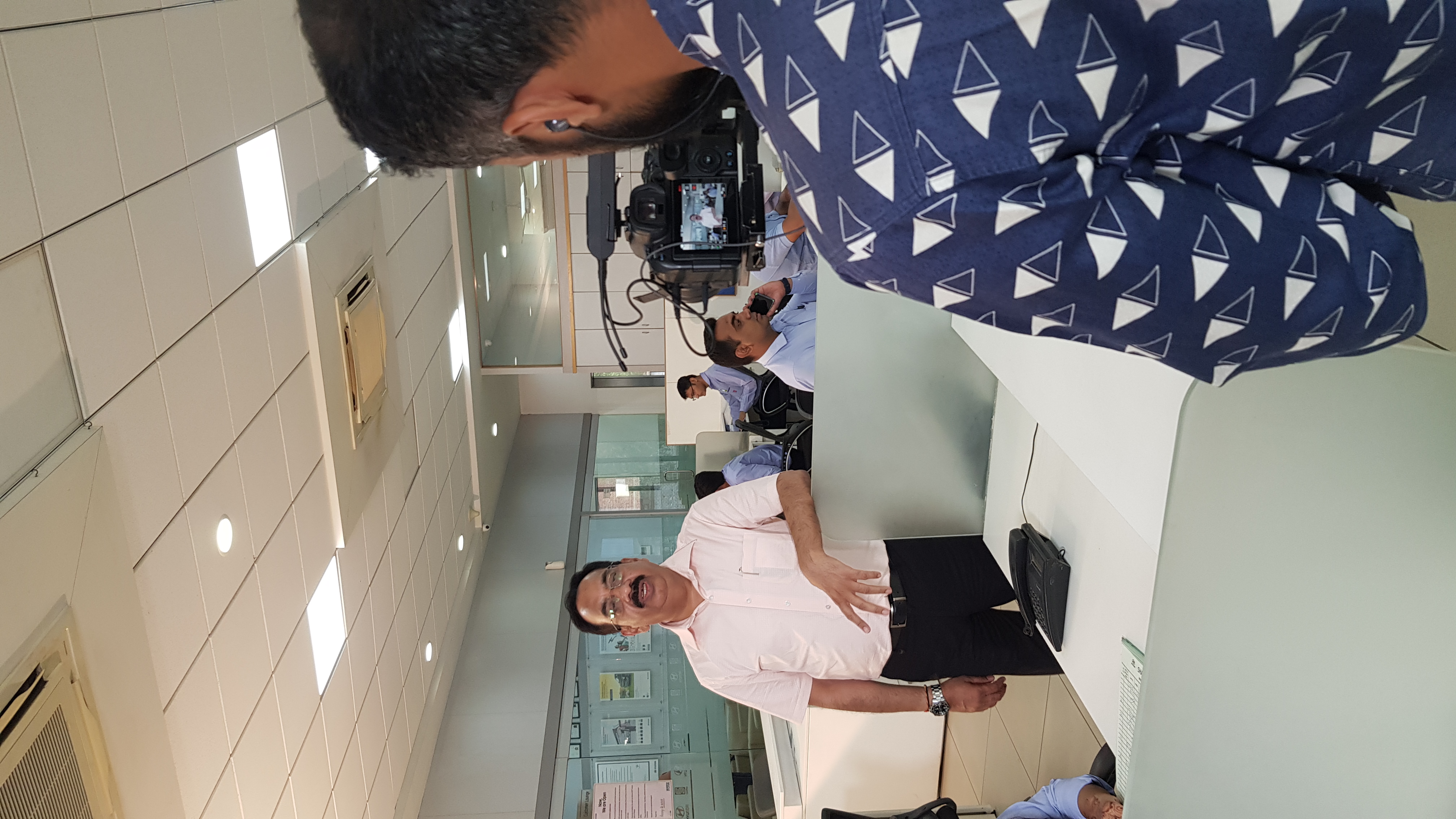 On location · Cosmos Production
The Right Partner Makes All the Difference
The difference between a corporate film that gets watched once and archived — and one that actively builds trust with every stakeholder who sees it — is not the camera, the location, or the budget. It is the thinking that happens before the camera is ever switched on.
A production house will give you beautifully shot footage. A communication strategist will give you a film that does a job. The best corporate films are made by teams that understand both — the craft of filmmaking and the science of communication.
Your corporate film is not a formality. It is one of the most powerful communication assets your brand has. Make sure it shows the world what your company truly stands for — not just what it looks like from the outside.